Has your business outgrown the way it operates?

Business Transformation designed to help ambitious SMEs overcome constraints and prepare for their next stage of growth.

True transformation isn’t about tinkering around the edges. It’s about reimagining how your business thinks, operates, grows, and performs so you can compete, thrive, and stay relevant in a rapidly changing world.

Chalkhill Blue’s Business Transformation Advisory service helps ambitious SME leaders deliver sustainable step changes that create measurable improvements in:

  • Financial performance
  • Operational efficiency
  • Leadership & organisational capability
  • Customer experience
  • Strategic clarity & competitiveness

The result? A stronger, more resilient business that grows faster, runs smoother, and increases long-term enterprise and shareholder value.

The Challenges Driving Transformation Today

What Is Business Transformation?

Business transformation is the structured reinvention of key parts of your organisation : strategy, operations, people, technology, culture, and financial performance to drive step-change improvements in operational efficiency, growth, and enterprise value.

It is NOT:

  • Firefighting
  • Cost-cutting alone
  • Light-touch consultancy
  • A one-off project

It IS:

  • Deep, meaningful change
  • Cross-functional improvement
  • A new operating model
  • A more capable leadership team
  • A future-ready business
  • A significant uplift in value

We make transformation achievable, measurable, and sustainable.

What You Will Achieve Through Transformation Advisory

Real transformation replaces quick fixes with lasting change, driving enterprise value to a new level.

Our clients typically experience:

  • A business that runs on strong margins and cost control
  • Faster, more reliable processes with far less rework
  • A capable leadership team with clear accountability
  • Higher employee engagement and better communication
  • A stronger customer experience and competitive position
  • Reduced dependency on the owner for day-to-day decisions
  • A resilient operating model built to handle complexity and scale
  • A business with materially higher enterprise value and a stronger position for a future exit

Phase 1

Diagnose & Prioritise

We begin with a forensic review across:

  • Strategy
  • Financials & margins
  • Cash flow & working capital
  • Operations & delivery
  • Leadership & culture
  • People & capability
  • Systems & technology
  • Customer experience
  • Market positioning

This identifies your performance gaps, scalability barriers, and high-impact opportunities.

Phase 2

Design the Transformation Blueprint

A clear and actionable plan built around:

  • Strategic direction & priorities
  • Operating model redesign
  • Commercial & financial improvements
  • Leadership and organisational development
  • Process streamlining
  • System upgrades & automation
  • Culture shift and accountability
  • Value creation roadmap

Your blueprint defines the step changes needed to reinvent how the business performs.

Phase 3

Implement & Embed Change

This is where transformation becomes real.

We help you:

  • Implement new processes
  • Introduce performance dashboards
  • Redesign roles, teams, and structures
  • Build middle-management capability
  • Improve financial controls
  • Launch cultural change initiatives
  • Introduce automation & technology
  • Strengthen customer experience

We work shoulder-to-shoulder with your leadership team to ensure progress sticks.

Phase 4

Optimise, Measure & Sustain

We build long-term accountability and clarity through:

  • Regular performance reviews
  • KPI dashboards
  • Operating rhythm design
  • Leadership coaching
  • Continuous improvement loops
  • Team capability building
  • System refinement

This creates a business that doesn’t just transform but continues to evolve.

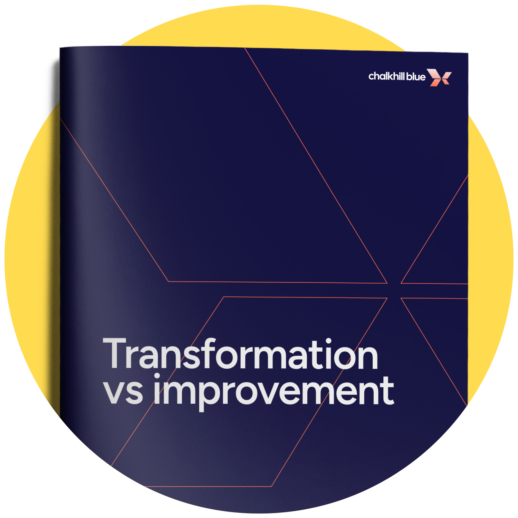
Whitepaper

Transformation vs Improvement

A guide for SMEs facing rising complexity and diminishing returns.

  • Why marginal gains now underperform
  • The difference between improvement and transformation
  • How AI and cost pressure change the rules
  • Where transformation creates leverage
Download now
image alt

AI Sam

Your business advisor

Need a quick answer? AI Sam is available 24/7 to answer questions, explain concepts and help you explore your options

Useful if:

The business has outgrown its operating model

Effort is increasing, but performance isn’t

Leadership is reactive rather than strategic

Accountability is unclear across the organisation

Profitability is under pressure

The business is too dependent on key individuals

Talk to Sam
image alt

Transformation Advisory FAQ’s

Explore our FAQ section for quick answers to your questions.

What is business transformation for SMEs?

Business transformation is a deliberate, structured intervention to materially improve how a business performs. It goes beyond incremental improvement and focuses on step-change gains in profitability, cash flow, leadership capability, operational efficiency, and enterprise value. For SMEs, transformation is often required when the current model no longer supports the next phase of growth or when performance has stalled.

When does a business need transformation rather than growth coaching?

When underlying structural issues are limiting performance. If margins are eroding, cash flow is under pressure, leadership capability isn’t keeping pace, or the operating model no longer scales, transformation is required. Growth coaching builds momentum; transformation fixes the foundations so growth becomes sustainable and valuable.

How do you know if your business needs transforming?

Common signals include declining profitability, increasing complexity, over-reliance on the owner, inconsistent delivery, weak accountability, and a sense that “working harder” is no longer improving results. If the business feels harder to run each year despite growing revenue, transformation is usually needed.

What areas of a business does transformation cover?

Transformation typically spans strategy, financial performance, operations, leadership structure, accountability, systems, culture, and governance. High-impact transformation focuses on the areas that most directly affect cash generation, scalability, and risk reduction.

How long does a business transformation take?

Initial stabilisation and performance improvement often occur within 90–180 days. Full transformation is about embedding new structures, leadership capability, and operating rhythms and typically takes 12–24 months. Speed depends on decisiveness, leadership alignment, and execution discipline.

Can business transformation improve profitability quickly?

Yes. Targeted transformation often delivers rapid margin improvement through pricing discipline, cost visibility, operational efficiency, and better commercial decision-making. Many SMEs discover profitability was being leaked rather than earned.

What causes transformation programmes to fail?

Lack of leadership commitment, unclear priorities, over-complex plans, and insufficient accountability. Transformation fails when it becomes theoretical rather than execution-led. Success requires ownership-level sponsorship and disciplined follow-through.

How do you transform a business without disrupting customers?

By sequencing change properly. Customer-facing operations are stabilised first, while internal inefficiencies and structural issues are addressed behind the scenes. Well-run transformation improves customer experience rather than damaging it.

Is business transformation just cost cutting?

No. Cost cutting without structural change is short-term and often destructive. Effective transformation improves profitability by redesigning how the business operates, not by simply reducing spend.

Can transformation help a business under financial pressure?

Yes. In fact, businesses under pressure often need transformation most urgently. Rapid diagnostic work followed by focused intervention can stabilise cash flow, restore control, and prevent value erosion.

How do you fix operational inefficiency in an SME?

By identifying bottlenecks, clarifying accountability, standardising key processes, and introducing performance metrics. Operational efficiency is about flow, ownership, and consistency, not bureaucracy.

What role does leadership play in transformation?

Leadership is decisive. Without capable leaders who can execute change, transformation stalls. Developing leadership depth and accountability is often one of the highest-ROI aspects of transformation.

How do you measure the success of a transformation programme?

Through improved profitability, stronger cash flow, reduced owner dependency, predictable performance, and higher enterprise value. Success is measured in results, not activity.

Can transformation help prepare a business for exit?

Absolutely. Buyers pay premiums for businesses that are well-run, predictable, and not reliant on the owner. Transformation directly improves saleability and valuation.

How do you manage cultural change during transformation?

By aligning incentives, leadership behaviour, and accountability with the desired outcomes. Culture changes when expectations and consequences change, not through slogans.

What’s the difference between transformation and turnaround?

Turnaround focuses on survival. Transformation focuses on creating a stronger, more valuable business model. Some businesses require both but transformation is what builds long-term value.

Can transformation help professionalise a business?

Yes. Many founder-led businesses reach a point where informal systems limit growth. Transformation introduces professional structure without losing entrepreneurial energy.

How involved does the owner need to be in transformation?

Highly involved at the strategic level. Owners don’t need to do everything but they must lead, sponsor decisions, and hold the organisation accountable.

What industries benefit most from business transformation?

Any SME experiencing growth pressure, margin squeeze, or operational complexity. Transformation is industry-agnostic because the underlying issues are structural, not sector-specific.

When should a business bring in external transformation advisors?

When internal capability or objectivity is insufficient to drive change at pace. External advisors accelerate decisions, reduce risk, and keep transformation commercially focused.

Start with a conversation that creates return

Whether you’re looking to scale, exit, transform, or regain control, the next step is a focused, commercial conversation. No pressure. No generic pitch. Just experienced insight designed to deliver a return on your time and investment.