
Business Funding Advisory: Secure the Right Funding for Growth

Funding Advisory that helps ambitious businesses secure the right capital, on the right terms, while protecting future growth, ownership and exit options.

Discuss your funding plans

The right funding can transform the trajectory of a business, unlocking growth, innovation, acquisitions, or operational expansion. But the wrong funding can hold you back for years.

Chalkhill Blue helps you raise the right capital, from the right sources, on the right terms, aligned fully to your growth ambitions and long-term value creation.

Chalkhill Blue helps you raise the right capital, from the right sources, on the right terms, aligned fully to your growth ambitions and long-term value creation.

Our Funding Framework

What Funding Advisory Covers

Our role is to make sure you raise capital strategically, not reactively.

We support you through:

  • Growth capital
  • Working capital
  • Acquisition finance
  • Asset finance
  • PE/VC investment preparation
  • Debt restructuring
  • Grant funding identification
  • Investor presentation preparation

Benefits of Smart Funding

  • Faster scaling
  • Improved liquidity
  • Stronger financial stability
  • Higher enterprise value
  • Access to new opportunities
  • Better negotiation power during exit

Chalkhill Blue helped us see our business differently. The combination of business coaching and strategic challenge materially improved both performance and confidence.

Founder & CEO
Engineering Services Business

For the first time, I’m not the bottleneck. The leadership team is performing brilliantly.

Founder
Professional Services

Their experience showed in every conversation. It felt like working with people who had genuinely been there themselves.

Managing Director
Multi-Site Trade Business

My role changed from firefighting to leading. The team is accountable and performance is up.

Founder
Professional Services

Before Chalkhill Blue, we were working hard but not seeing the profitability we should have been. Now we understand our numbers, our margins, and our drivers. The structure and systems we have implemented have completely changed how we operate.

Whatley & Co.

Before finding Chalkhill Blue, we had struggled for a number of years and whilst we were busy, we had no idea how to build a highly profitable or scalable business. Growth Coaching strengthened our systems and profitability. When rapid growth created cash pressure, the funding strategy gave us the confidence to continue accelerating. We now feel in control of both performance and ambition.

James Gillate
Managing Director, Roots Shoots and Leaves

As founders who advise other SME owners on acquisition, scaling and transformation, we knew we had to hold ourselves to the same standard. By applying structured integration, transformation and scale up discipline, we have repositioned the business, strengthened performance and built a platform for sustainable growth. Walking our own talk has deepened both our credibility and our capability.

Rachel Spratling
Director, Chalkhill Blue

Prior to working with Chalkhill Blue, I was trying to do too many job roles at once and was heavily involved as a technician in my own business. Now the company runs with far more structure and clarity and I am focused on leading as Director and making strategic decisions that drive growth.

Harry Hislop
Managing Director, HRHislop

Chalkhill Blue challenged us when it mattered most—and helped us make better decisions as owners.

Founder
Manufacturing & Distribution Business

They brought board-level thinking without corporate baggage. The clarity they gave us directly increased enterprise value.

Owner-Director
Professional Services Group

The report quickly highlighted why growth felt harder than it should. We left with three clear priorities.

Managing Director
£4m Engineering Business

Simple, practical and surprisingly accurate. It showed us exactly what needed attention next.

Director
£7m Construction Business

Before working with Chalkhill Blue, everything depended on me. I was constantly reacting to problems and always playing catch up. Now the business has structure. The team understands their roles, processes are clearer and I can finally focus on leading rather than firefighting.

Martin Pockett
Managing Director, MKL Groundworks

We freed up over 40 hours a month by fixing our operational bottlenecks.

CEO
Manufacturing

We secured investment after restructuring the business for scale.

Tech Founder

Before Chalkhill Blue, we were exhausted and questioning whether we should continue. We were working constantly but not moving forward strategically. Growth Coaching gave us clarity, structure, and the confidence to lead properly. The transformation in both the business and our mindset has been extraordinary.

Kaye Merriman
Managing Director, Little Angels

It helped us focus on the financial measures that actually drive better decisions.

Founder
£4m Recruitment Business

Our processes are now scalable, our culture is stronger, and our results are consistent.

Managing Director
Construction

This wasn’t consultancy—it was partnership. Commercial, practical, and grounded in reality.

CEO
Technology SME

The report highlighted gaps in our cash-flow visibility and gave us practical actions to improve it.

Managing Director
£3m Professional Services Firm

Whitepaper

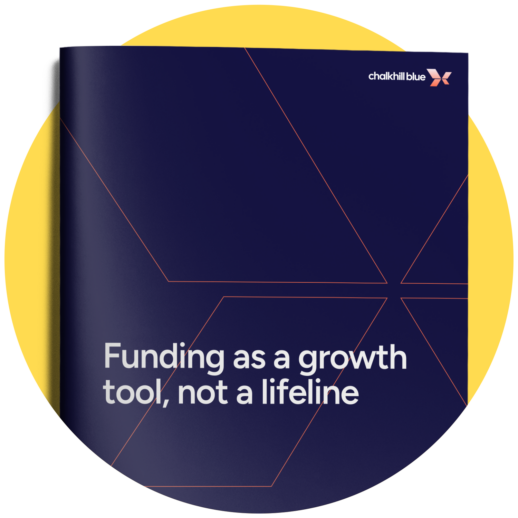
Funding as a Growth Tool

A practical guide to using funding deliberately rather than reactively.

  • Why growth often worsens cash flow
  • The difference between funding as fuel vs funding as survival
  • How lenders and investors assess business risk
  • When debt, equity, or hybrid funding actually fits


Download now
image alt

Still comparing funding routes?

Alternatively, if you're still exploring your options, tell AI Sam about your business and your ambitions, confidentially. Sam can help explain the different services and suggest which may be the best fit.

Funding Advisory FAQ’s

Explore our FAQ section for quick answers to your questions.

What funding options are available for businesses in the UK?

UK businesses can access a wide range of funding options including bank debt, asset finance, private debt, equity investment, private equity, venture capital, grants, and hybrid structures. The right option depends on growth objectives, cash-flow resilience, appetite for dilution, and long-term plans such as acquisition or exit. Funding should be a strategic enabler, not a short-term fix.

How do I know which type of funding is right for my business?

The right funding aligns with where the business is heading, not just where it is today. This requires clarity on growth plans, risk tolerance, cash generation, and future exit ambitions. Poorly aligned funding can restrict strategic options, create cash pressure, or force premature exits.

What’s the difference between debt and equity funding?

Debt preserves ownership and control but increases financial risk through repayments and covenants. Equity reduces short-term cash pressure but dilutes ownership and often introduces external influence. The wrong choice can materially reduce long-term value.

How do I prepare my business for funding?

Preparation involves credible forecasts, clean financials, clear strategic rationale, and evidence the leadership team can execute. Most funding failures occur not because capital isn’t available, but because businesses are not investor-ready.

What do investors look for in businesses?

Investors look for capable leadership, predictable earnings, scalable models, strong margins, disciplined reporting, and a clear route to value creation. Confidence in management is often more important than the business model itself.

How much funding can my business realistically raise?

This is driven by cash generation, risk profile, growth potential, and leadership capability, not headline revenue. Over-raising or under-raising both create problems.

What are the risks of taking on external funding?

Risks include loss of control, restrictive covenants, misaligned investor expectations, increased pressure on cash flow, and reduced exit flexibility. Funding magnifies both strengths and weaknesses.

Can funding help accelerate growth safely?

Yes – when combined with disciplined execution and governance. Capital without structure increases risk; capital with clear ROI targets accelerates value creation.

How do I improve my chances of securing funding?

By presenting a coherent growth story, robust financials, realistic assumptions, and a leadership team investors trust to deliver. Confidence comes from preparation, not persuasion.

What financial information do lenders require?

Lenders typically require historic accounts, cash-flow forecasts, balance-sheet detail, covenant projections, and evidence of repayment capacity. Transparency builds credibility.

How long does a funding process take?

Typically 3–9 months depending on complexity, preparation quality, and funding route. Poor preparation lengthens timelines and weakens negotiating position.

Should I raise funding before or after scaling?

Generally after stabilising performance and proving scalability. Raising capital too early often results in poor terms and unnecessary dilution.

How does funding affect future exit options?

Funding structures influence buyer appetite, valuation, and deal complexity. Poor funding decisions can limit exit routes or reduce sale proceeds.

What is investor readiness?

Investor readiness means the business can withstand scrutiny, deliver predictable results, and communicate value clearly under pressure.

Can funding help with acquisitions?

Yes – but acquisition funding must protect the core business, preserve cash flow, and align with long-term value creation.

How do I avoid giving away too much equity?

By improving performance first, raising capital from a position of strength, and structuring deals intelligently around valuation, governance, and exit.

What KPIs matter most to investors?

Profitability, cash conversion, growth quality, customer retention, leadership effectiveness, and capital efficiency.

How do you structure funding to protect control?

Through minority investments, staged funding, governance clarity, and aligned incentives that support performance without unnecessary interference.

When should companies avoid raising capital?

When fundamentals are weak, leadership capacity is stretched, or funding would mask deeper issues rather than solve them.

How do I deploy funding effectively after raising it?

By tying capital deployment to clear ROI targets, accountability, and performance tracking. Capital should be treated as an investment, not a buffer.

Funding decisions shape far more than cash flow

They influence growth, ownership, acquisition opportunities and exit options. The next step is a focused commercial conversation to understand your funding readiness and identify the capital strategy best suited to what comes next.

Submit this form to book a call with a funding expert.