

EOT Advisory: Is Employee Ownership the Right Exit Route for Your Business?

EOT Advisory designed to support successful ownership transitions while protecting value, culture and long-term business performance.

Discuss your EOT plans

Employee Ownership Trusts (EOTs) are one of the fastest-growing, most tax-efficient, and culturally transformative ownership models in the UK.

Establishing and managing an EOT requires independent oversight, governance discipline, and trustee expertise.

Chalkhill Blue helps organisations design and manage the transition to a EOT as well as providing experienced, impartial Independent EOT Trustees who ensure fairness, transparency, compliance, and long-term stewardship of the business for all employee beneficiaries.

The Role of the Independent Trustee

Why Businesses Choose Employee Ownership

  • Reduced CGT for qualifying owners
  • Improved culture & employee engagement
  • Stronger retention
  • Increased productivity
  • Long-term business continuity
  • A values-led alternative to trade sale
  • Protection of brand, culture & legacy

But without strong governance, EOTs can fail to deliver their full potential.

Why Choose Chalkhill Blue for Independent Trustee Support

  • Strong commercial & operational experience
  • Deep understanding of business dynamics
  • Expertise in governance, culture, and leadership
  • Balanced, impartial, independent judgment
  • Practical approach to supporting employee-led organisations
  • Focus on long-term sustainability and value creation

We ensure the EOT model works, not just legally, but commercially.

Simple, practical and surprisingly accurate. It showed us exactly what needed attention next.

Director
£7m Construction Business

They brought board-level thinking without corporate baggage. The clarity they gave us directly increased enterprise value.

Owner-Director
Professional Services Group

This wasn’t consultancy—it was partnership. Commercial, practical, and grounded in reality.

CEO
Technology SME

For the first time, I’m not the bottleneck. The leadership team is performing brilliantly.

Founder
Professional Services

Before finding Chalkhill Blue, we had struggled for a number of years and whilst we were busy, we had no idea how to build a highly profitable or scalable business. Growth Coaching strengthened our systems and profitability. When rapid growth created cash pressure, the funding strategy gave us the confidence to continue accelerating. We now feel in control of both performance and ambition.

James Gillate
Managing Director, Roots Shoots and Leaves

Our processes are now scalable, our culture is stronger, and our results are consistent.

Managing Director
Construction

We freed up over 40 hours a month by fixing our operational bottlenecks.

CEO
Manufacturing

It helped us identify where too many decisions were still relying on me. We made changes almost immediately.

Founder
£2m Professional Services Firm

The assessment exposed a few risks we'd never considered. It gave us a clear plan to strengthen the business.

Managing Director
£6m Manufacturing Business

Before Chalkhill Blue, we were working incredibly hard but constrained by our traditional training model. The move to e learning required difficult decisions, including scrapping an LMS build we had invested heavily in. That was tough. However, the focus on profitability, scalability, and disciplined execution transformed the business and ultimately delivered the valuation we achieved.

Kate Gardner
Director, Grey Matter Learning

Prior to working with Chalkhill Blue, I was trying to do too many job roles at once and was heavily involved as a technician in my own business. Now the company runs with far more structure and clarity and I am focused on leading as Director and making strategic decisions that drive growth.

Harry Hislop
Managing Director, HRHislop

It highlighted where value could be lost in a future sale and helped us prioritise improvements.

Founder
£5m Distribution Company

As founders who advise other SME owners on acquisition, scaling and transformation, we knew we had to hold ourselves to the same standard. By applying structured integration, transformation and scale up discipline, we have repositioned the business, strengthened performance and built a platform for sustainable growth. Walking our own talk has deepened both our credibility and our capability.

Rachel Spratling
Director, Chalkhill Blue

We realised we had plenty of data but not enough insight. The recommendations were simple and actionable.

Owner
£5m Construction Business

The preparation they guided us through years ahead of exit completely changed the outcome.

Founder & Shareholder
Family-Owned Business

The report highlighted gaps in our cash-flow visibility and gave us practical actions to improve it.

Managing Director
£3m Professional Services Firm

Chalkhill Blue has played a central and pivotal role in this transaction. Their commercial insight, technical understanding and ability to coordinate the entire deal team made the process seamless and gave us absolute confidence that we were making the right decision for our whole team and our clients.

Andrew Lloyd
Director, Acaster Lloyd

It helped us focus on the financial measures that actually drive better decisions.

Founder
£4m Recruitment Business

The support we have received has been invaluable. We knew we had a strong business with a great reputation, but we needed help refocusing on the leadership team and thinking more strategically about the future. Chalkhill Blue has helped us sharpen our focus on what really drives performance, brought structure and discipline to our board meetings, and provided the kind of challenge and insight that only comes from people who have built and scaled businesses themselves. For me personally, it has also helped me step back from the day to day running of the business and focus more on the long term direction of the company. With Chalkhill Blue supporting the board and leadership team, we now have the confidence to pursue growth opportunities across Europe while continuing to strengthen the business at home.

Ian Beswick
Founder, AP Air Europe

A quick exercise with some very useful insights. It changed how we think about preparing for exit.

Owner
£8m Technology Services Business

Whitepaper

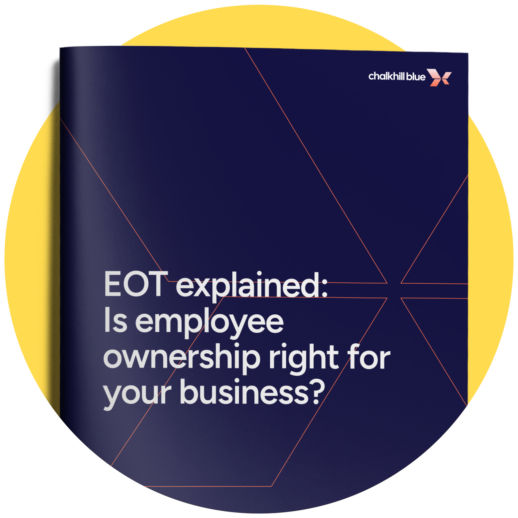
Is Employee Ownership Right for Your Business?

A strategic, financial, and cultural guide to Employee Ownership Trusts (EOTs).

  • What an EOT actually is (and what it isn’t)
  • When EOTs work well and when they don’t
  • The cash-flow realities founders must understand
  • Why governance matters more than tax relief
Download now
image alt

Not sure whether you need coaching or a Non-Executive?

Alternatively, if you're still exploring your options, tell AI Sam about your business and your ambitions, confidentially. Sam can help explain the different services and suggest which may be the best fit.

EOT Advisory FAQ’s

Explore our FAQ section for quick answers to your questions.

What is an Employee Ownership Trust?

An Employee Ownership Trust (EOT) is a structure where a controlling interest in a company is held on behalf of employees. It allows founders to exit in a tax-efficient way while preserving independence, culture, and long-term continuity.

How does an EOT work in practice?

The trust acquires shares from existing owners, funded through future profits. Employees benefit collectively, while governance structures ensure the business remains commercially disciplined and compliant.

What are the tax benefits of an EOT?

Qualifying shareholders can sell shares at reduced rates of Capital Gains Tax. This makes EOTs one of the most tax-efficient exit routes available to UK business owners.

Is an EOT better than selling to a third party?

It depends on objectives. EOTs prioritise legacy, culture, and continuity over maximising headline price. For owners who value long-term stewardship, EOTs can be an attractive alternative.

How do I know if my business is suitable for an EOT?

The business must be profitable, cash-generative, and capable of operating without the founder. Weak governance or reliance on the owner typically make EOTs unsuitable.

What does an Independent EOT Trustee do?

An Independent Trustee protects employee interests, ensures compliance, oversees governance, and provides objective challenge to management. Their role is critical to maintaining trust and commercial discipline.

Why is independent governance important in an EOT?

Without independent oversight, conflicts can arise between management, employees, and former owners. Strong governance ensures decisions remain aligned with long-term business health.

How does an EOT protect business culture?

By embedding long-term ownership and stewardship. Employees have a collective interest in sustainable performance rather than short-term extraction.

What happens to leadership after an EOT transition?

Strong leadership remains essential. EOTs are not self-managing; they require capable management teams and clear accountability to succeed.

How are employees represented in an EOT?

Employees are represented through trustee structures and formal engagement mechanisms that balance voice with commercial realism.

How is the business valued in an EOT sale?

Valuation is based on affordability, sustainability, and long-term performance. Unrealistic pricing undermines the model and repayment viability.

How long does it take to set up an EOT?

Typically 6–12 months, including planning, valuation, financing, and governance design.

What are the risks of employee ownership?

Poor governance, unclear leadership accountability, and unrealistic expectations. Without discipline, EOTs can underperform.

Can founders still be involved after an EOT?

Yes. Many founders remain during transition or in leadership roles, provided boundaries and accountability are clear.

How is performance managed in an EOT business?

Through the same commercial disciplines as any high-performing company: clear leadership, KPIs, incentives, and accountability.

What reporting is required under an EOT?

Regular financial reporting, trustee updates, and employee communication are required to maintain transparency and trust.

How do EOTs repay the selling shareholders?

Repayment is typically funded from future profits over time, making cash flow discipline critical.

Can EOTs access funding?

Yes, though lenders scrutinise governance, cash flow, and leadership more closely than in traditional structures.

How do EOTs impact long-term growth?

Well-run EOTs often outperform due to higher engagement and continuity, but only where governance and leadership are strong.

When should an EOT be avoided?

When profitability is weak, governance is unclear, or founders are unwilling to relinquish control meaningfully.

An EOT can protect culture, reward employees and preserve founder legacy

But successful transitions rarely happen by accident. The next step is a focused commercial conversation to understand your current level of EOT readiness and the practical steps needed to create a successful employee-owned future.

Submit this form to book a call with an employee ownership expert.